
 AI Knowledge Club Admin
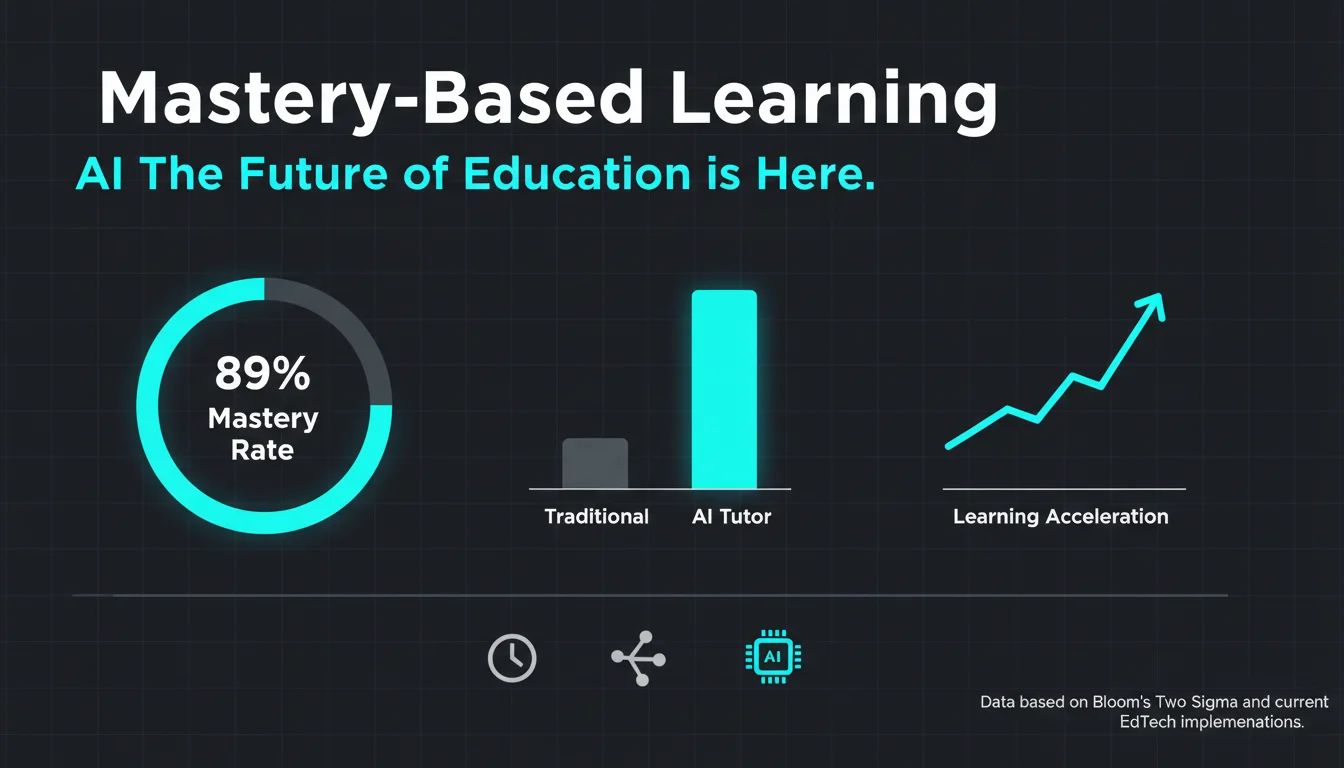
Mastery-Based Learning AI: The Future of Education is Here
Most learning systems operate on an outdated principle. Students move forward based on a schedule, not on their actual understanding. This factory model pushes everyone along at the same pace, regardless of who is ready and who is not. As a result, knowledge gaps form and widen silently. The system wasn’t designed for mastery; it was designed for scale. Intelligent tutoring systems finally give us a way to fix that.
That model is crumbling. And honestly? It’s about time.
Two forces are stepping in to replace it. Mastery-Based Learning changes how students progress. Agentic AI Tutors make that progress possible for everyone, not just a few. This isn’t a future prediction. It’s happening now in classrooms and companies around the world.
The 2026 Context: Why AI Tutors Must Prove Efficacy
We are now in 2026. The era of AI experimentation is over. AI has moved from a novelty to the operating fabric of business, life, and learning. The focus has shifted from “Can AI do this?” to “How well does it do it?” This is the Efficacy Imperative. Organizations no longer find flashy demos impressive; they seek measurable results.
In education and training, this means the pressure is on to prove that learning investments lead to real competency. Simply completing a course is not enough. The new standard is demonstrated mastery. Platforms that cannot deliver and prove this level of efficacy are becoming obsolete. Mastery-Based Learning AI is the engine built to meet this demand.
Key Takeaway: By 2026, the demand for measurable learning outcomes makes AI-driven mastery a necessity, not a feature.
What is Mastery-Based Learning?
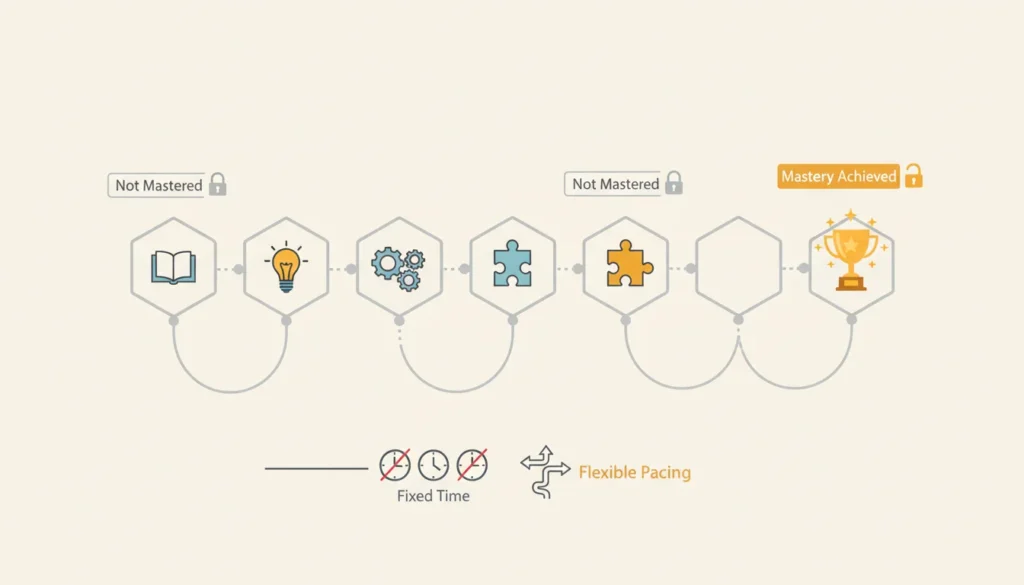
The principle of Mastery-Based Learning is simple: you don’t move on to the next topic until you have truly mastered the current one. This is a radical departure from traditional, time-based models that assume learning happens just because a certain amount of time has passed. MBL, also known as Competency-Based Progression, requires proof of understanding.
In practice, this model involves:
- Clear Learning Objectives: Defining exactly what “mastery” looks like for each concept.
- Frequent Checkpoints: Using formative assessments to gauge understanding, not just to assign a final grade.
- Targeted Support: Providing Automated Remediation for learners who struggle, helping them catch up before they move on.
- Flexible Pacing: Allowing learners to take the time they need, or to accelerate if they grasp concepts quickly.
The power of this approach was proven decades ago. In a landmark 1984 study, educational psychologist Benjamin Bloom found that students taught with a mastery approach performed, on average, one standard deviation better than those in traditional classes. This is the foundation of his famous 2-Sigma Problem: how to get the results of one-on-one tutoring in a one-to-many classroom setting. For decades, it was an unsolvable logistical puzzle.
Key Takeaway: Mastery-Based Learning prioritizes proven competency over time spent, but limited instructor bandwidth has historically constrained its implementation.
From Static Chatbots to Agentic AI Tutors
The solution to the 2-Sigma Problem has arrived in the form of AI. But not just any AI. The early chatbots were static tools, little more than interactive FAQs. The new generation is entirely different. We are now in the era of Agentic AI Education.
An Agentic AI Tutor is a proactive, intelligent system designed to guide a learner toward mastery. It does what a human tutor does, but at an infinite scale. The difference between a simple chatbot and an Agentic AI Tutor is vast.
Static AI (The Old Way)
- Reactive: Waits for a user to ask a specific question.
- Generic: Provides the same pre-programmed answer to everyone.
- Stateless: Treats every interaction as new, with no memory of the learner’s history or struggles.
Agentic AI Tutors (The 2026 Standard)
- Proactive: It doesn’t wait to be asked. Emotion AI analyzes interaction patterns, hesitation, and even facial cues via webcam. It detects when a learner feels frustrated, confused, or bored. It can then intervene with encouragement or a new approach.
- Personalized: It adapts explanations based on the learner’s specific mistakes and learning history. It shifts from text to video to interactive examples based on what works for that individual.
- Stateful: It remembers every interaction, building a detailed cognitive profile of the learner to inform future guidance. It understands why a student is stuck.
This is the shift from pre-set learning paths to true adaptive learning workflows in 2026. The AI doesn’t just provide answers; it provides Dynamic Scaffolding, adding and removing support in real-time as the learner’s competence grows.
Key Takeaway: Agentic AI Tutors are proactive, personalized partners that use data and Emotion AI to guide learners, fundamentally differing from reactive chatbots.
Making Your LMS “Agent-Ready” for AI Tutors
An Agentic AI Tutor cannot function on a traditional, static Learning Management System (LMS). The platform’s underlying technology must be prepared for this new reality. To survive, an LMS must become “Agent-Ready.” This requires a focus on two key technical concepts: machine-readable data structures and protocols like MCP (Model Context Protocol).
An AI agent needs to “read” your course content not as a flat wall of text or a video file, but as structured data. It needs to understand:
- What are the core learning objectives of this lesson?
- Which specific concepts does this quiz question test?
- How does this video segment relate to that PDF handout?
This is where machine-readable education content becomes critical. You must tag, structure, and organize your content so that an AI can parse it. Without this, the AI is flying blind.
MCP and similar protocols act as the universal translator between your content and the AI model. They provide a standardized way to package the context of a learning interaction—who the learner is, what they are working on, their recent performance, and the relevant course materials. This allows an AI tutor to have a rich, meaningful conversation with the learner because it has all the necessary background information. An LMS that doesn’t support this is a locked box.
Key Takeaway: For an AI tutor to be effective, the LMS must have machine-readable content and use protocols that give the AI structured context for every learner interaction.
Solving the Bottleneck: Scaling Outcomes with AI Tutors
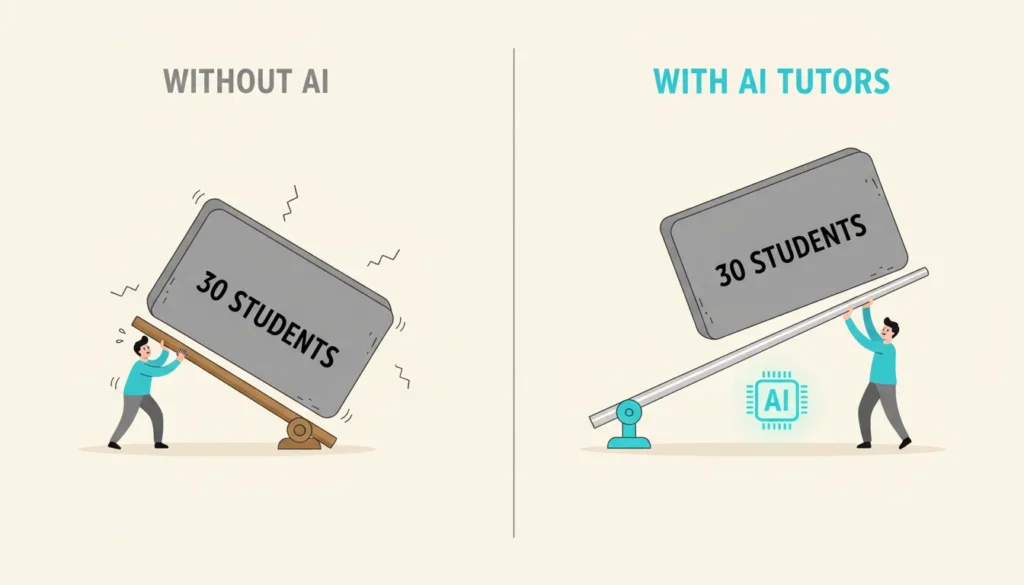
The core challenge of MBL has always been the “one-to-many” bottleneck. A single instructor cannot create personalized remediation paths for 30, 100, or 1,000 learners simultaneously. Platforms built on WordPress, like LearnDash, are powerful but were not designed for this level of dynamic personalization.
This is the bottleneck that AI shatters. It finally solves the 2-Sigma Problem at scale.
Here’s how Mastery-Based Learning AI achieves this:
- Automated Remediation: When a learner fails a quiz, the system doesn’t just say “Try Again.” An agentic workflow identifies the specific concepts they failed and automatically serves a personalized “remediation playlist” of videos, articles, or practice problems.
- Predictive Analytics: By analyzing a learner’s Time-to-Mastery on previous modules, the AI can build Predictive Learning Models. These models can flag a learner who is at risk of falling behind before they fail, allowing for proactive intervention from a human instructor.
- Personalized Learning Paths via Agentic AI: The AI dynamically adjusts the entire learning journey. For a student struggling with a core concept, it might insert a foundational micro-lesson. For an advanced learner, it might offer optional expert-level challenges.
For those considering building an AI tutor for LearnDash, this is the goal. It’s not about adding a chatbot widget. It’s about architecting a system where the AI can manage personalized learning paths for every user, freeing up human instructors to focus on mentoring, coaching, and deeper engagement.
Key Takeaway: AI solves the scaling problem of Mastery-Based Learning by automating the creation of personalized support and remediation paths for every individual learner.
The Future is About Outcomes, Not Content
The value proposition of online education is shifting. Content is abundant and cheap to produce. Learners and organizations are no longer paying for courses; they are paying for outcomes. They want proof of skill, verified competency, and measurable performance improvement.
A platform built on Mastery-Based Learning and powered by Agentic AI delivers exactly that. The system directly links learning activities to competencies, provides data to support them, and ensures that no learner is left behind. This is the new competitive advantage.
The transition requires more than a plugin. It demands a strategic shift in how we design courses, structure content, and integrate technology. The platforms that embrace this change will define the next generation of education. The ones that don’t will be left behind.
Learn more about building these systems at AI Knowledge Club, your home for insights on agentic AI, adaptive learning, and the future of digital education.