 AI Knowledge Club Admin
The New Chinese AI Models You Should Be Watching in 2026
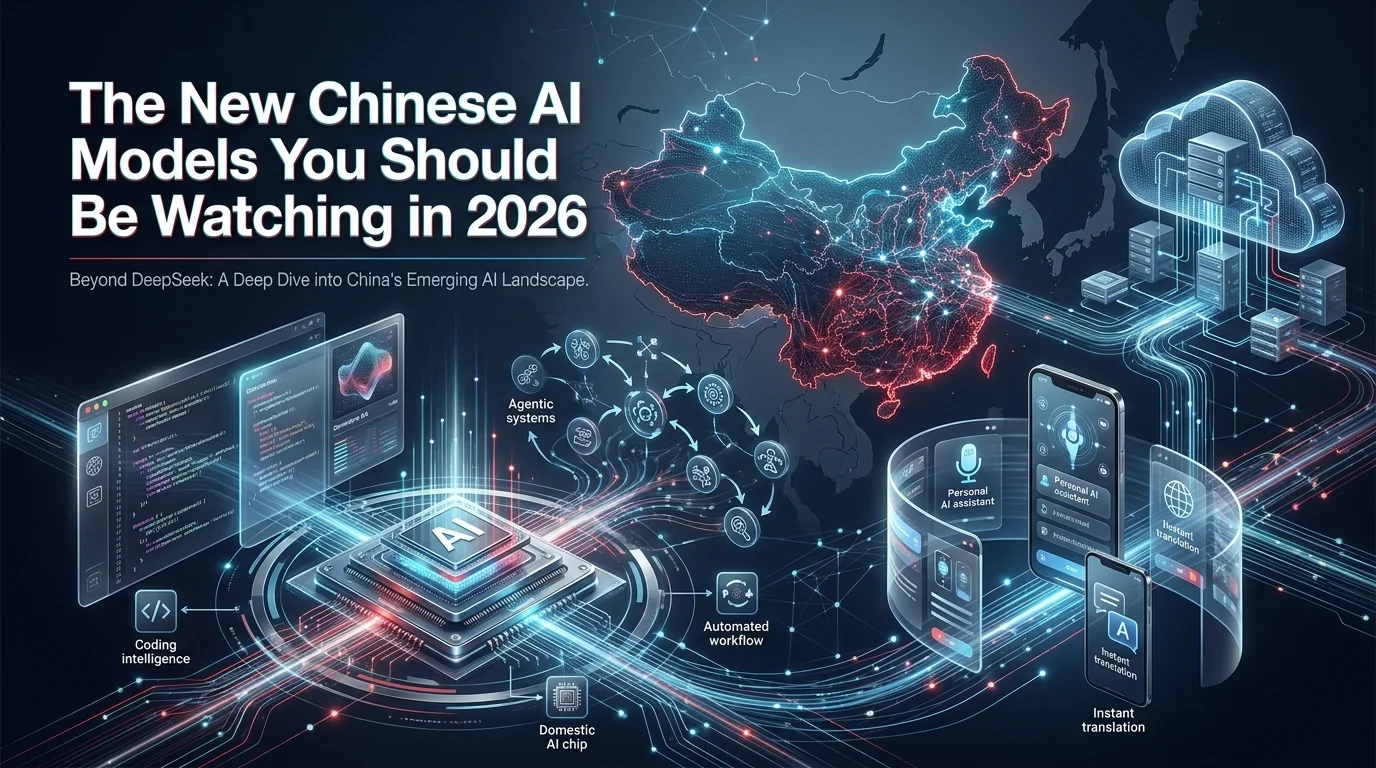
Most global AI coverage still circles the same names: OpenAI, Google, Anthropic, and maybe DeepSeek. But that picture is now too narrow. China’s AI race has become much broader, with major new models coming from Alibaba, Zhipu, ByteDance, Xiaomi, Moonshot AI, MiniMax, and Tencent. Some are built for coding. Some are built for long-running AI agents. Some are winning huge consumer audiences. Others are being designed to work better on domestic chips or smaller devices.
That is what makes this story worth watching. China is no longer relying on one surprise breakout model. It is building a deeper bench across consumer apps, developer tools, multimodal systems, and agent-style AI. For readers outside China, many of these names still feel unfamiliar. That may not last much longer.
Why the China AI Race Is Bigger Than DeepSeek
DeepSeek helped put Chinese AI back into the global conversation, but it did not end the story. The China AI race is now much bigger than one breakout model. Reuters’ reporting from early 2026 showed a crowded field of Chinese AI players, including Alibaba, ByteDance, Tencent, Zhipu, MiniMax, and Moonshot AI, all pushing new products and models at roughly the same time. The competition is no longer only about benchmark scores. It is also about distribution, cost, ecosystem strength, and whether AI can move from chat into real action.
The most important shift is that China’s AI market is now developing on several tracks at once. One track is agentic AI, where models do multi-step tasks instead of just answering prompts. Another is open or developer-friendly models that can spread fast. Another is consumer distribution, where apps gain massive usage through existing platforms. And another is hardware adaptation, especially as Chinese companies try to get strong performance from domestic chips and smaller devices.
Alibaba Qwen 3.5 and the Rise of Agentic AI in China
Alibaba’s Qwen 3.5 is one of the clearest examples of where this race is going. Reuters reported that Alibaba unveiled Qwen 3.5 on February 16, 2026 and positioned it for the “agentic AI era.” The company said the model was 60% more cost-efficient and eight times better at handling large workloads than its predecessor. Reuters also reported that Alibaba described it as having visual agentic abilities, meaning it could take actions across phone and computer apps.
That matters because Alibaba is not framing Qwen as just a smarter chatbot. It is framing it as an action layer. In plain terms, Alibaba wants AI that can do things, not just talk about them. That is a very important distinction. If that strategy works, Qwen could become part of a broader ecosystem across commerce, enterprise tools, and daily workflows. In other words, Alibaba’s AI push looks less like a single model release and more like a platform play.
Zhipu GLM-5 Strengthens China’s AI Race in Coding and Domestic Chips
Zhipu’s GLM-5 may be one of the most important Chinese models that many global readers still overlook. Reuters reported that Zhipu released the open-source GLM-5 on February 11, 2026 with stronger coding capabilities and support for long-running agent tasks. Zhipu said the model approached Anthropic’s Claude Opus 4.5 on coding benchmarks and beat Gemini 3 Pro on some tests.
But the bigger strategic point came later. Reuters reported on March 31 that Zhipu had deeply optimized GLM-5 for domestically produced Chinese chips and said it had reached performance efficiency comparable to top global chips. The same Reuters report said Zhipu’s 2025 revenue rose 132%, its cloud API revenue jumped 292%, and it raised API pricing by 83% after usage surged 400%. That makes GLM-5 important for more than coding. It sits at the meeting point of model capability, commercial demand, and hardware independence.
For the wider AI market, that is a big signal. If hardware constraints remain a major issue for Chinese labs, then the companies that learn to squeeze more out of domestic chips could become much more influential. GLM-5 is one of the clearest examples of that trend right now.
ByteDance Doubao 2.0 Shows How Chinese AI Models Scale Through Consumer Distributiontion
ByteDance’s Doubao 2.0 matters for a different reason. It is not only about model capability. It is about reach. Reuters reported that ByteDance released Doubao 2.0 in February 2026 while Doubao was already leading China’s AI chatbot market with 155 million weekly active users based on QuestMobile data published in late December.
Then came the bigger consumer story. Reuters reported that during China’s Lunar New Year holiday, Doubao passed 100 million daily active users. It also handled 1.9 billion AI-related queries through a major Spring Festival push. That surge made Doubao one of the strongest examples of how AI adoption can accelerate when a company already knows how to build mass consumer habits. ByteDance is not just making a model. It is plugging AI into a machine built for scale.
This matters because the global AI race will not be decided by benchmarks alone. Distribution matters. A model that reaches millions of people quickly can shape habits, collect feedback, and improve products faster. Doubao 2.0 is a reminder that in China, the winners may not only be the labs with the strongest technical claims, but also the platforms that can get AI into everyday life fastest.
Xiaomi MiMo-V2-Pro Brings Hardware Brands Into the China AI Race
Xiaomi is one of the more surprising names in this story, which is exactly why MiMo-V2-Pro deserves attention. Reuters reported that Xiaomi unveiled MiMo-V2-Pro in March 2026. The model quickly gained attention on OpenRouter and had already processed more than 1.5 trillion tokens. Around the same time, CEO Lei Jun said Xiaomi would invest at least 60 billion yuan in AI over the next three years.
That is important because Xiaomi is not known mainly as an AI lab. It is known for phones, consumer electronics, and now electric vehicles. When a company like Xiaomi starts investing at this scale and ties its model strategy to agent workloads, it suggests the AI race is spreading into the hardware ecosystem in a deeper way. AI is no longer just something built by pure software companies. It is becoming part of the broader device stack.
That could matter globally. If companies like Xiaomi integrate AI models tightly with phones, smart devices, cars, and operating systems, then the next phase of AI competition may depend as much on hardware distribution as on model quality. MiMo-V2-Pro is one sign that this shift is already happening.
Moonshot Kimi K2.5 Shows China AI Models Can Win Global Developers
Moonshot AI’s Kimi K2.5 is one of the clearest examples of a Chinese model that could travel well beyond its home market. Moonshot’s official model page says Kimi K2.5 was officially released on January 27, 2026 and describes it as an open-source multimodal model that can handle text, code, and visual content. Moonshot’s main site says Kimi supports online search, deep thinking, multimodal reasoning, and long-form conversations.
What gives Kimi K2.5 extra relevance is outside adoption. Cloudflare announced on March 19 that Kimi K2.5 was added to Workers AI and described it as a frontier-scale open-source model with a 256k context window, multi-turn tool calling, vision inputs, and structured outputs for agentic workloads. Cloudflare also said it had been using Kimi internally for agentic coding tasks and automated code review.
That matters because when a Chinese open model lands on a major global developer platform, it becomes easier for developers around the world to test it, compare it, and build on top of it. Kimi K2.5 is not just a local success story. It is part of the broader open-model wave.
MiniMax M3 Keeps China AI Race Focused on Open Models and Global Growth
MiniMax belongs in this conversation even though its newest flagship model is still on the way. Reuters reported on March 2, 2026 that MiniMax planned to release its M3 model in the first half of 2026. The same Reuters report said the company wants to compete both as a model maker and as a product platform, while using an open-source approach to attract outside developers.
That is important because MiniMax reflects a larger pattern in China’s AI sector. The goal is not only to build one strong model. The goal is to build products, attract developers, and create a platform around the technology. Reuters also reported that MiniMax’s 2025 revenue rose 159% year over year, with more than 70% of sales coming from outside China. That suggests it is already thinking globally, not just domestically.
Even before M3 officially arrives, MiniMax is worth watching because it shows how serious the broader ecosystem race has become. In China’s AI market, being good at models may not be enough. You also need distribution, product depth, and developer pull.
Tencent Hunyuan Shows Why Deployable China AI Models Matter
Tencent’s AI strategy is easy to underestimate if you only look for the loudest model launch. Reuters reported on March 18, 2026 that Tencent would soon release Hunyuan 3.0 and was building a new AI agent for WeChat. The same report said Tencent had launched the OpenClaw AI suite for individuals, developers, and enterprises. A later Reuters report said Tencent had integrated WeChat with an OpenClaw-based agent called ClawBot, pushing further into task automation inside one of China’s most important digital ecosystems.
What makes Tencent especially interesting is the combination of big-platform reach and deployable AI. It is not just betting on a bigger cloud model. It is also tying AI into messaging, payments, and practical digital tasks. That gives Tencent a very different advantage from a startup model lab. It can turn AI into a feature inside products people already use every day.
The broader lesson is simple: not every strategically important AI model has to be huge. The next phase of competition may reward systems that are easier to deploy, cheaper to run, and tightly connected to existing products. Tencent’s direction points toward that future.

The bigger trend: agents, open models, hardware adaptation, and distribution
That makes China’s AI race more interesting than a simple East-versus-West scoreboard. It is a story about how different AI ecosystems form. In China, that ecosystem now looks broader, more practical, and more distributed than many outside observers still realize. Some companies are chasing frontier performance. Some are chasing user scale. Some are chasing independence from foreign hardware. Some are chasing agentic workflows. Together, they are building a more layered AI market.
Final thoughts
If you have only been following the biggest Western AI names, it is easy to miss how quickly China’s model ecosystem is expanding. Qwen 3.5, GLM-5, Doubao 2.0, MiMo-V2-Pro, Kimi K2.5, MiniMax, and Tencent’s Hunyuan push all point to the same conclusion: the China AI race is no longer just about one breakout model or one familiar name. It is about a wider set of companies building across agents, coding, mobile hardware, developer platforms, and consumer distribution.
Many readers may not know these names yet. But several of them are becoming harder to ignore. And if the current pace continues, the next stage of the global AI race will be shaped not only by the models everyone already talks about, but also by the ones many people still have not heard of.