
 AI Knowledge Club Admin
GEO vs SEO: 5 Strategies to Get Cited by AI Search Engines in 2026
The traditional “blue link” era is fading fast. By 2026, over 70% of online searches will end without a single click. Users now get their answers directly from AI overviews. Organic traffic is plateauing for many online businesses, forcing marketers to adapt to a massive shift in user behavior. This is where Generative Engine Optimization (GEO) comes in, driven by a new success metric called “Share of Synthesis,” which measures how often AI models use your data to generate answers.
Partnering with a generative engine optimization agency is becoming a necessity. It is the natural evolution for digital marketing partners. The old search methods simply do not capture this new AI-driven traffic.
To stay relevant, brands must adapt their content strategies quickly. You must shift your focus from simply “ranking” to “citing.”
The Evolution of Search: From Traditional SEO to GEO
Search technology has changed fundamentally. Traditional search engines provide a ranked list of links. Modern answer engines synthesize raw data into one direct response.
Keywords vs. Entities
AI does not just scan pages for strings of text. It looks for strong, verified entity association. It wants to know exactly who you are and what you do.
For example, AI models like Gemini use Knowledge Graphs. These graphs verify if your brand is a true authority. Being an expert in the WordPress ecosystem requires more than keyword stuffing.
Traditional search engine positioning still matters for baseline visibility. But it is only the starting point. You need to prove your entity is the definitive source in your niche.
Basic, affordable search engine optimization tactics often miss this mark entirely. They focus heavily on outdated ranking factors. They fail to build true entity trust and topical authority.
The Information Gain Gap
AI models are trained on massive public datasets like Wikipedia. They do not need you to repeat basic, widely known facts.
They are looking for “Information Gain.” This is a specific scoring system used by search algorithms. It rewards content that provides new data or unique perspectives.
You must offer insights that the AI has not summarized yet. Original research and unique expert opinions boost your information-gain score.
Mastering the Mechanics of GEO
You cannot optimize for AI search by guessing. You need a practical, structured approach to your content. Here are five strategies to secure AI citations in 2026.
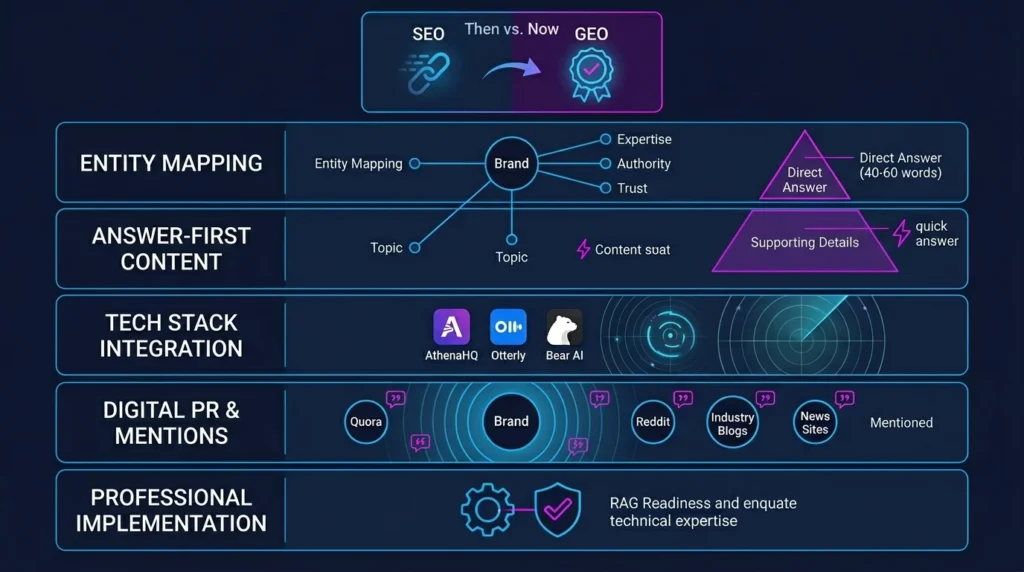
1. Mastering Semantic Entity Mapping for GEO
Start by mapping your brand to very specific topics. You want AI engines to connect your name with your core expertise.
Link your business name to relevant concepts clearly. If you run a WordPress training platform, tie your brand to “LMS scalability.”
- Publish comprehensive glossary pages defining key industry terms.
- Use schema markup extensively across your entire website.
- Maintain consistent author bios that highlight real-world credentials.
This structured data gives AI clear definitions of your entities and relationships.
2. Answer-First Content Architecture
AI bots scan content quickly to find facts. They look for clear, direct, and unambiguous answers. You should adopt the “inverted pyramid” writing style.
Provide a clear fact block immediately after an H2 question. Keep this summary block between 40 and 60 words.
- Remove introductory fluff from your headings.
- State the core fact or solution in the first sentence.
- Use bullet points to list steps clearly.
Make it easy for bots to scrape and cite your answer. You can elaborate on the finer details further down the page.
3. Deploying Leading-Edge Tech Stacks for GEO Visibility
You cannot track AI citations with traditional SEO tools alone. You need software built for this specific purpose.
Agencies now rely on leading software for AI visibility and generative engine optimization. Tools like AthenaHQ, Otterly, and Bear AI are popular choices.
These platforms track your specific “Share of Voice” inside large language models. They show you exactly where your brand appears in AI answers.
4. Digital PR for Citation Velocity
Traditional backlinks alone will not secure AI citations. You need active, authentic brand mentions across the web.
Third-party mentions build deep trust with AI systems. Focus on getting cited in niche forums and high-authority news sites.
- Answer complex questions on Quora and Reddit.
- Publish guest posts on respected industry blogs.
- Release original survey data that others naturally quote.
AI engines constantly scrape these community platforms. They use them to find authentic human opinions and verify your brand’s reputation.
5. Professional Implementation
Managing these new optimization requirements is highly complex. It goes far beyond updating meta tags and compressing images.
Many businesses are now seeking generative engine optimization services. They need experts to handle complex technical tasks and strategy.
Professionals ensure your content architecture is perfectly aligned with AI reading patterns. They can also prepare your site for Retrieval-Augmented Generation (RAG) requirements.
Beyond the Click: The New ROI of Generative Engine Optimization
Website clicks are no longer the only metric of success. You must measure how often AI systems trust and recommend your brand.
Success Metrics for the AI Era
You might wonder how to track progress in this new landscape. Understanding how to measure the success of generative engine optimization campaigns requires new key performance indicators.
- AI-Generated Visibility Rate (AIGVR): This shows how often your brand appears in AI summaries.
- Citation Sentiment: Does the AI describe your brand as an “industry leader” or just “an alternative option”?
- Share of Synthesis: The percentage of AI answers in your niche that use your proprietary data.
Use GA4 for Referral Source Tracking. You can isolate traffic coming specifically from AI engines. Set up custom channel groupings for sources like chatgpt.com or perplexity.ai.
The Future Belongs to the “Citable”
Generative Engine Optimization is not replacing traditional SEO. It is the professional upgrade path you must take to survive.
Search engines will still drive valuable traffic for years to come. But AI engines are capturing the most critical, high-intent queries today.
Take time to audit your entity footprint right now. Ensure your brand is clearly defined and easy for machines to quote.
Adjust your content structure to provide direct, factual answers. Give the AI exactly what it needs to summarize your expertise.
Don’t just rank on page one—become the answer.
Add Your Heading Text Here
Add Your Heading Text Here
Add Your Heading Text Here